
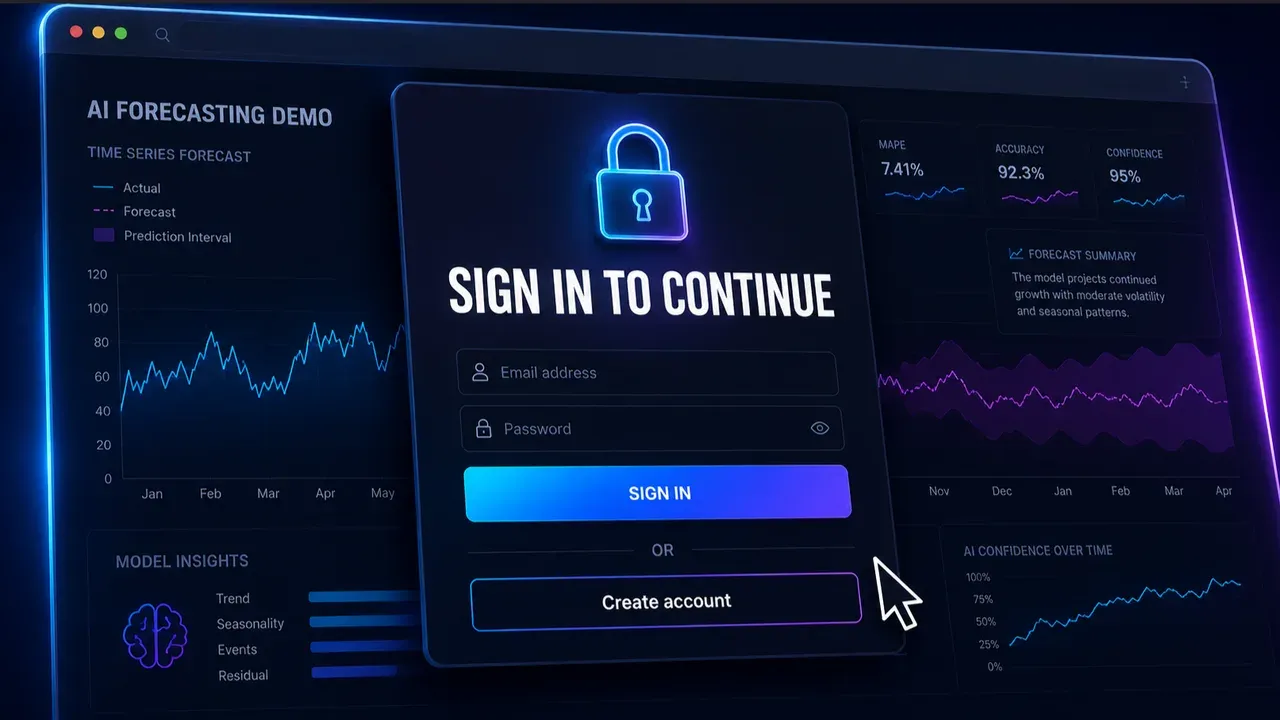
Freeing Forecasting Foundation Models from Artificial Gatekeeping
If you come across a forecasting foundation model today, there is a good chance that it will promoted as a gated service, behind a user registration and commercial API that you have to pay for.
Examples are hyperscaler models like Amazon Chronos-2, IBM Granite TTM, and Google TimesFM 2.5, or models of companies largely, or entirely dedicated to this business model.
Whether or not the models are open weights, permissively licensed (so in theory you could run them yourself), the sales story is often like this:
“Our model is already convienently set up for you, on the cloud of us, your friendly vendor. You do not need to go through the hassle of setting up your own cloud, juggle with microservices, Python environments, service APIs, and so on.
You are saving the cost of 100 senior engineers, hardware for 12 blade servers, and the time to setup which is at least 7 times 77 days, in return for paying a minuscule, almost vanishing monthly subscription fee plus token costs (66.6 dollars per month, subject to terms and conditions), and sending your data to some place in the US, which is really just an insignificant formality.”
Or - are you really?
(above, exaggerated for humour - but we will revisit the actual economics below)
The Fake Trade-off between “convenient” gated models and sovereignty
The sales story constructs a fake trade-off between convenience on one side, and privacy, sovereignty, control on the other.
It entices the user to believe these two sides are mutually exclusive: that sovereignty necessarily means hiring an army of specialist developers.
The trade-off is fake, it relies on a “false dichotomy”.
Open foundation models by the same providers are, typically, unnecessarily hard to run, with unnecessarily large model sizes, or unnecessarily difficult Python setups, frustrating even the most seasoned developers.
But as China has previously shown with DeepSeek for LLMs:
the same performances can be obtained with smaller and cheaper models.
For time series foundation models the sales trap is even worse: many state-of-art models can already run easily in your browser.
Quantized versions reduce loading and inference times even further, often without significant performance loss.
Models in your browser - unraveling the marketing spin
Upload a time series, and receive the result within seconds or less - without sending your data to a forecasting server, and without signing up on some dodgy AI company’s webpage.
Especially without the need to pay anyone anything - this runs on your computer! And not just that, but even in your browser.
Zero senior developers, zero blade servers, zero installation complexity, zero subscription fees - just you and your browser.
How does it work?
This little proof-of-concept uses WebAssembly.
WebAssembly is an official web standard that allows compiled, high-performance code to run directly inside the browser. It gives web applications access to near-native computational performance without requiring users to install a native application.
Our application downloads and caches the model and inference runtime, then performs preprocessing, inference, and postprocessing locally on the user’s device. The uploaded time series data and resulting forecasts never leave your computer.
(Our guide for do-it-yourself, and the proof that this really just ran in your browser)
The economic implication
Of course the above is just a toy example.
Proving that a foundation model runs in your browser may be surprising, but the browser architecture is not the point. The point is that computation and models have become commoditized enough and efficient enough, so there is no fundamental reason to run them on someone else’s cloud.
So, what does it mean for your bottom line?
For a mid-sized company with non-digital core business (a manufacturer, a retailer, an energy provider), a plausible order of forecasts, anomaly detections, recommendations, etc, per day might be 100.000 or less. Perhaps 5.000 products, materials, machines, across 20 locations.
We just saw one prediction in a fraction of a second; downloading and caching the model takes maybe a second, depending on your internet connection, but has to happen only once.
Since the day has about 100.000 seconds (86.400, to be exact), you can easily run all your forecasts in a day.
And remember: we are speaking about the browser of an arbitrary trash laptop, not specialized AI hardware or your self-managed cloud.
Of course you need to prepare data and send it to the model - ERP extraction, data cleaning, ETL, integration gateways and so on. But this has to be done anyway - whether you use a trash laptop’s browser, or a provider of gated models, if the model is the API surface.
In particular, this means: if you are one of these mid-sized companies above - or, even larger, but without super large and high velocity data collection, you do not need a gated model provider.
Even worse: if you send your data to an external API provider, it is not only a privacy or sovereignty issue - but you introduce a new technical boundary to your system, which you have to maintain and which can introduce new failure sources.
The question you should be asking: “Why are we paying someone else to run a model that our existing infrastructure can already handle, while introducing additional interfaces, problems and risks?”
Takeaways
This experiment, and the calculation above, highlight multiple takeaways:
- local setup of state-of-art forecasting foundation models is as easy as opening this webpage
- with minor effort state-of-art foundation models can be made to run efficiently even on standard consumer hardware,
- and easy to deploy as part of an automatic install, suitable for almost all local hardware architectures - including your laptop right now!
- convenience and sovereignty are, therefore, not just no opposites, but easy to guarantee at the same time!
So, looking at the business models of gated forecasting foundation model providers: The Temperor has no clothes.
Buyer beware!
But why are we sold the naked (t)emperor?
Two plausible reasons. Either the subscription is overpriced, or the old saying about the brave new silicon world proves true, “if you are not paying for it, then you’re not the customer - you are the product”. Namely:
Forecasting data often contains commercially sensitive information, such as sales, demand, energy consumption, production volumes, or machine telemetry.
These are exactly the kinds of data that tech companies have historically considered extremely valuable, and also exploited against interests of the data owners.
From this viewpoint, buying a subscription to a gated time series foundation model, at the current state-of-art (and under the assumptions of the above calculation), is an unnecessary capitulation to a future in which the control of your own core business data infrastructure is no longer yours.
And probably it also costs you more (see the calculation above).
Instead, liberate your data!
The model can go where the data lives, instead of forcing your data on a pilgrimage to where the model is hosted (usually somewhere in California, Texas, or the US East Coast).
sktime already provides Python-native interfaces for maximal user convenience in putting a large variety of foundation models in production under your control. See our growing selection of easy-to-use Python APIs
Get in touch with us to help you put AI that you own, in your own database, and watch this space for our upcoming tools that will make this even easier!
Where others offer SaaS (Software as artificial Servitude), we offer liberation.
Where others offer FaaS (Freedom as a Service, for Premium US citizens only, Terms and Conditions apply), we offer true freedom. Made in the EU. And for your year-end balance sheet.